Export Google Forms Responses to Google Docs and Word
To turn answers into an editable document, choose a response-export operation. Exporting the form itself creates a question document instead. Once the correct Google Doc exists, use Google Docs’ download menu to save a Microsoft Word copy.
This distinction matters when a colleague asks for “the form in Word.” They might mean a blank questionnaire, a readable record of submitted answers, or a report that interprets those answers. Start by deciding which output they need.
Pick the right output
| Request | Suitable starting point |
|---|---|
| A blank questionnaire for editing or printing | Export the form’s questions |
| A document containing submitted answers | Export responses to Google Docs |
| Selected submissions for a case review | Use a response-selection export if available |
| Numbers to sort, filter, or calculate | Keep a spreadsheet or CSV workflow |
| An editable file for a Word user | Review the Google Doc, then download a .docx copy |
An exported document is not automatically an analysis. If someone needs trends, recommendations, or a workshop summary, add that editorial work after checking the response data. The workshop feedback report example illustrates that separate task.
Open the document conversion options
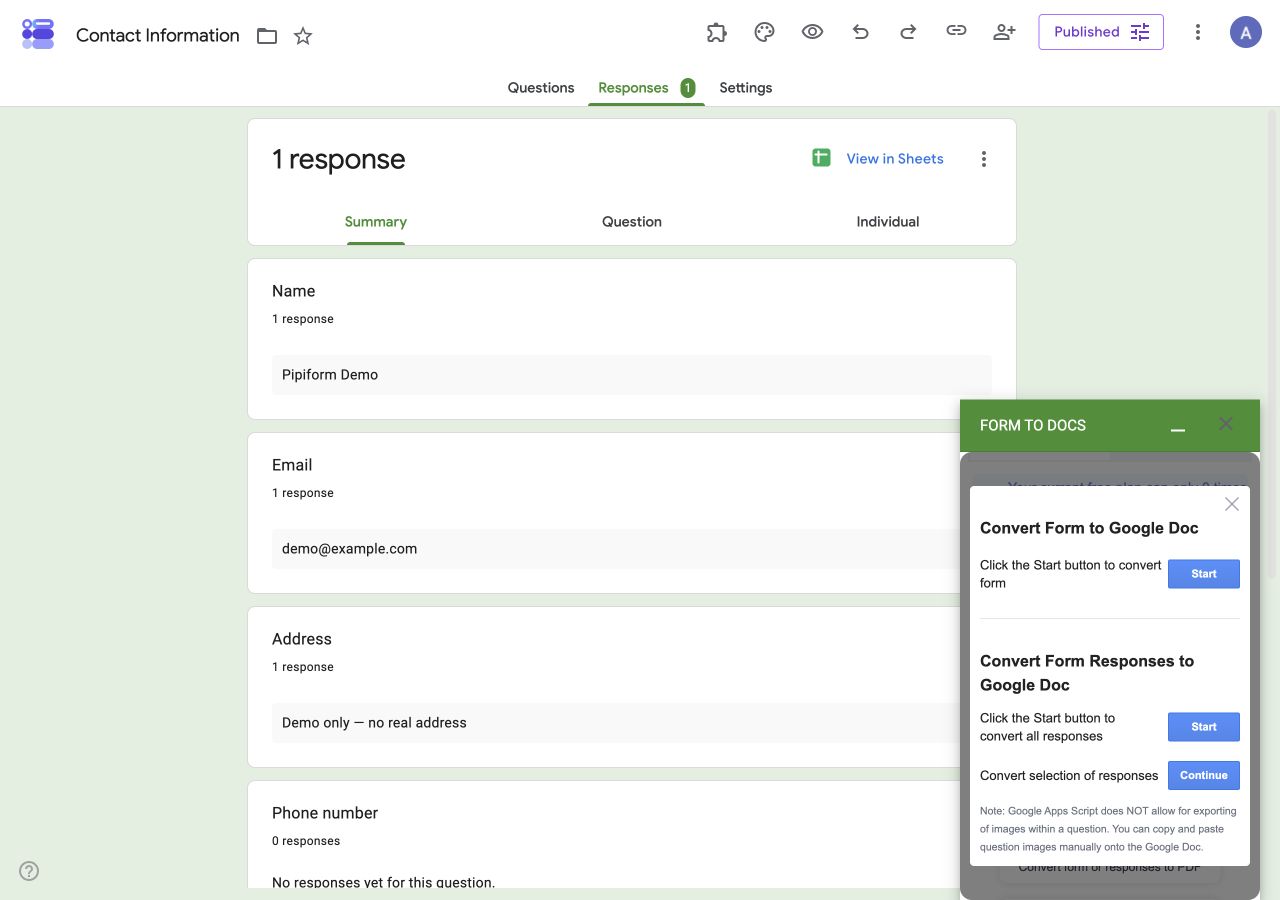
In your form’s desktop editor, open Add-ons → Form to Doc - Doc to form → Open. In Convert From Form, choose To Doc.
The inspected interface presents separate operations for the form, all responses, and a selection of responses. Read the heading above the button instead of choosing the first Start button.
If the add-on is not installed, the Pipiform Forms to Docs page links to its Marketplace listing. If the menu is missing, start with add-on troubleshooting.
Export a small sample before a large set
First confirm that the expected submissions appear in the form’s Responses tab. An empty response collection cannot provide the answer content you are trying to export.
Choose the response operation, review any selection or destination prompts, and check your account’s available conversions before starting. If you only need a few submissions, inspect the selection option instead of exporting an entire dataset by default.
Our test account displayed zero remaining free conversions during this inspection. We therefore verified the available controls but did not run a fresh response conversion. In the earlier test, the form-export operation successfully created a Google Doc containing question labels and blank answer lines. That successful blank-form export does not prove the layout of a response export.
After your conversion finishes, open the resulting Doc and compare a sample with the original submission. Check long answers, blank optional fields, question order, and any helper fields introduced by other add-ons. In our blank-form example, timer helper fields appeared in the generated document, so an editorial cleanup step was necessary before sharing it as a questionnaire.
The converter also displays a warning about question images and suggests adding them manually to the Doc. Treat image handling as something to inspect in your output; do not promise a perfect copy of the original form.
Download the Google Doc as a Word file
Open the reviewed document in Google Docs, choose File → Download, then select Microsoft Word (.docx). We confirmed that option in the actual English desktop menu below. Google’s file download instructions describe choosing a file type from this menu.
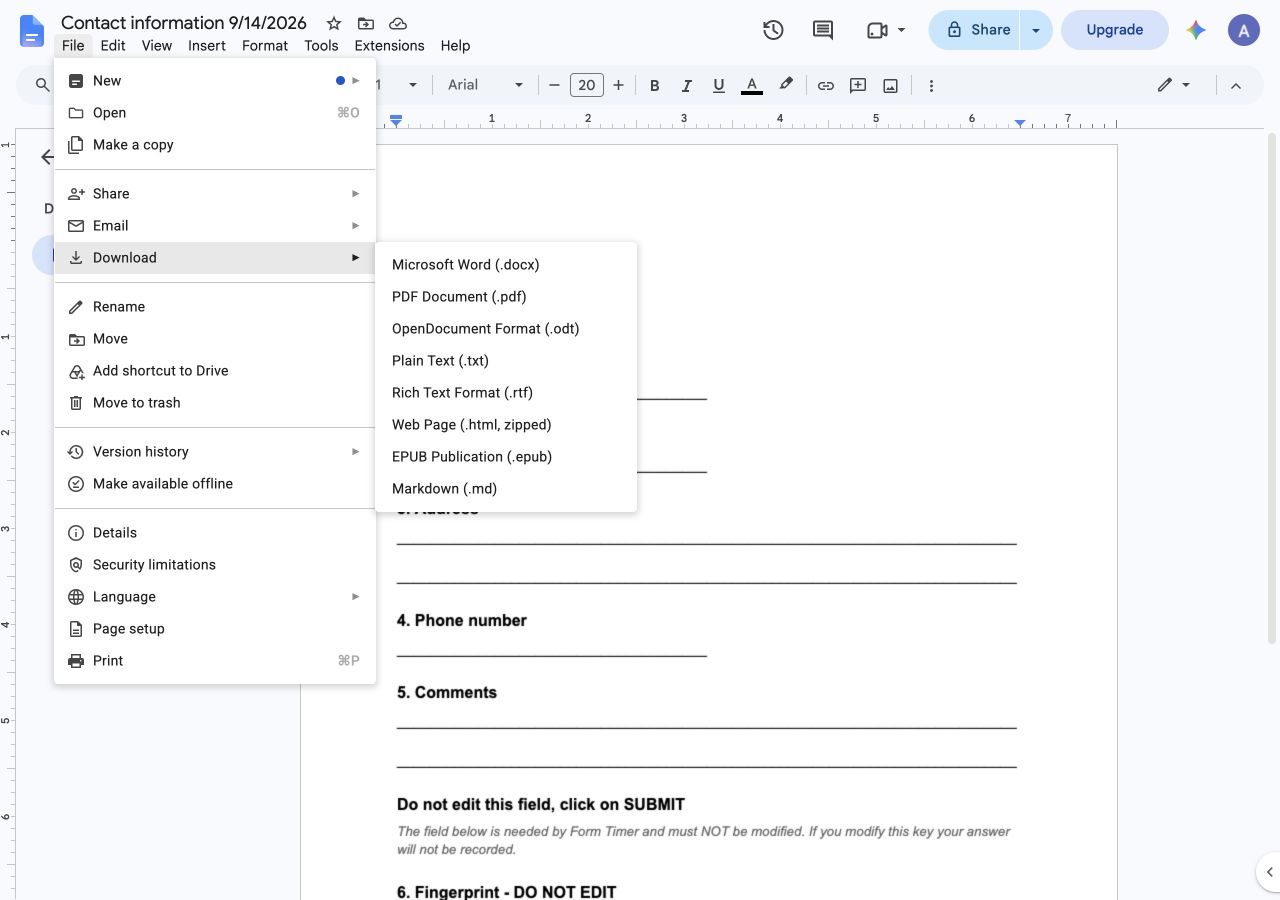
Actual download menu on the previously generated blank-question document. The screenshot demonstrates the Word download route, not a completed response export.
Open the downloaded copy in the application your recipient uses. Look at page breaks, tables, headings, and wrapped text. A file that downloaded successfully can still need layout adjustments.
Name the file so its scope is clear—for example, “Workshop responses — September review — selected entries.” Record when it was exported. A downloaded Word copy should be treated as a snapshot unless you have separately configured and verified an update workflow.
Diagnose the most common mismatches
| What you see | What to check |
|---|---|
| Questions followed by empty lines | You may have selected the form-export operation |
| Fewer entries than expected | Compare the selected response scope with the Forms backend |
| Missing question images | Review the converter warning and add images where needed |
| Technical helper questions | Remove unnecessary fields from the shareable document copy |
| A conversion limit or upgrade prompt | Review the current account allowance before retrying |
| A document that looks fine online but breaks in Word | Inspect the downloaded .docx in the recipient’s application |
Do not solve a document-formatting problem by deleting response data from the original form. Keep the source submissions intact and edit the output copy.
Frequently asked questions
Why did I get a blank questionnaire instead of answers?
The form and response operations are separate. Check which heading was above the Start button you selected.
Can I export only selected responses?
The inspected To Doc interface includes a selection option. Review its available controls and account requirements before running it; this inspection did not complete a selected-response export.
Is CSV the same as a Word document?
No. CSV is tabular data. Word is usually a better fit when someone needs an editable narrative document or a readable case record.
Will the Word copy update after another submission?
Do not assume it will. Treat a downloaded file as a snapshot and export a new copy when needed, unless a separate automation has been configured and tested.
What if I need PDF instead?
Choose the format that matches the recipient’s task. For the mobile PDF workflow, see converting Google Forms responses to PDF on iPhone.