Google Forms Conditional Email Notifications: A Setup Guide
Use Google Forms’ built-in notification when you just need a new-response alert. Use an add-on when the recipient or message should depend on an answer. For example, a contact form could route workshop questions to one person and other enquiries to a general inbox.
This guide uses the English desktop interface of Pipiform’s Form Notifications add-on. We inspected the message and recipient steps and created an unsaved example condition. We did not enable a rule or send a test email.
Choose the simplest notification that meets your need
| What you want | Where to start |
|---|---|
| Know that a new response arrived | Forms → Responses → more-options menu → email notifications |
| Give respondents a copy of their answers | Forms settings for email collection and response receipts |
| Customize a message or select recipients by an answer | A notification add-on’s message and conditional-recipient settings |
Google describes the first two options in its response-management documentation. A response receipt and a notification to a team member serve different purposes; configure them separately.
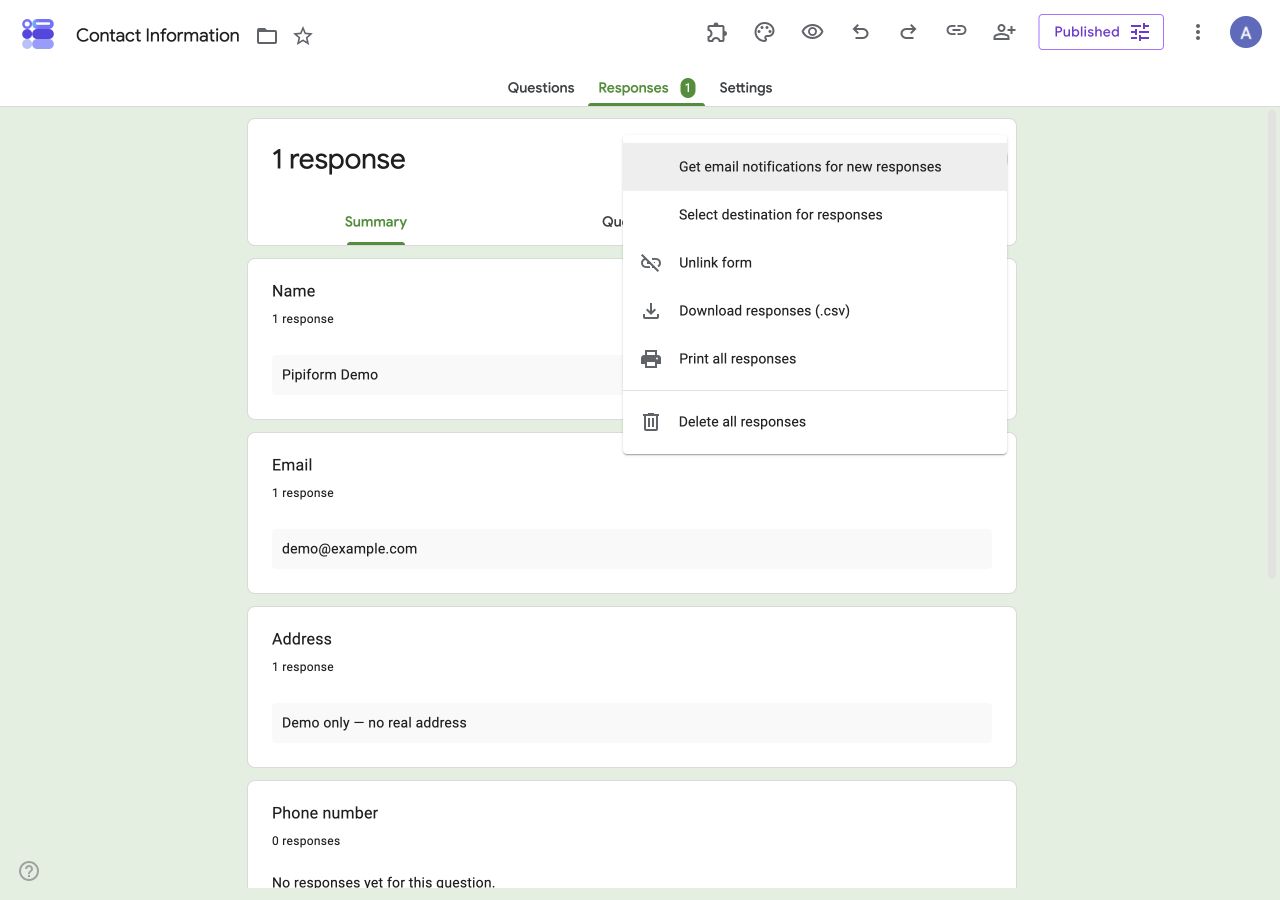
Actual desktop menu. Start here if a simple alert is enough; you do not need a conditional rule for every use case.
Open Pipiform’s notification editor
In the form editor, click the puzzle-piece Add-ons button and choose Form Notifications for Google Forms™ → Open App. Click Create, then choose Email Notification. If you need installation information, use the Pipiform notification product page.
Choose a descriptive notification name. “Workshop enquiries” is easier to maintain than “Notification 1,” especially when a form grows to include several workflows.
The Message step includes sender details, a reply-to address, a subject, and a message body. The interface also offers variable-field controls and message markers. Insert fields through those controls and check the resulting preview or test message; typing a field name incorrectly can leave a placeholder unresolved.
Write only what the receiving team needs. For a first notification, a short subject, the relevant answer, and a clear next action are usually easier to scan than a long branded email. Avoid putting unnecessary response details in the subject line.
Set recipients and an answer condition
Continue to Recipients. The interface separates ordinary To, CC, and BCC recipients from respondent notifications and conditional notifications.
- Review any prefilled recipient. Do not assume it is the team mailbox you intended.
- Decide whether the person who submitted the form should receive a separate message.
- Enable the conditional-notification option.
- Select a form field and a matching condition.
- Enter the comparison value and the recipient for that condition.
- Review the fallback recipient for answers that match none of the condition sets.
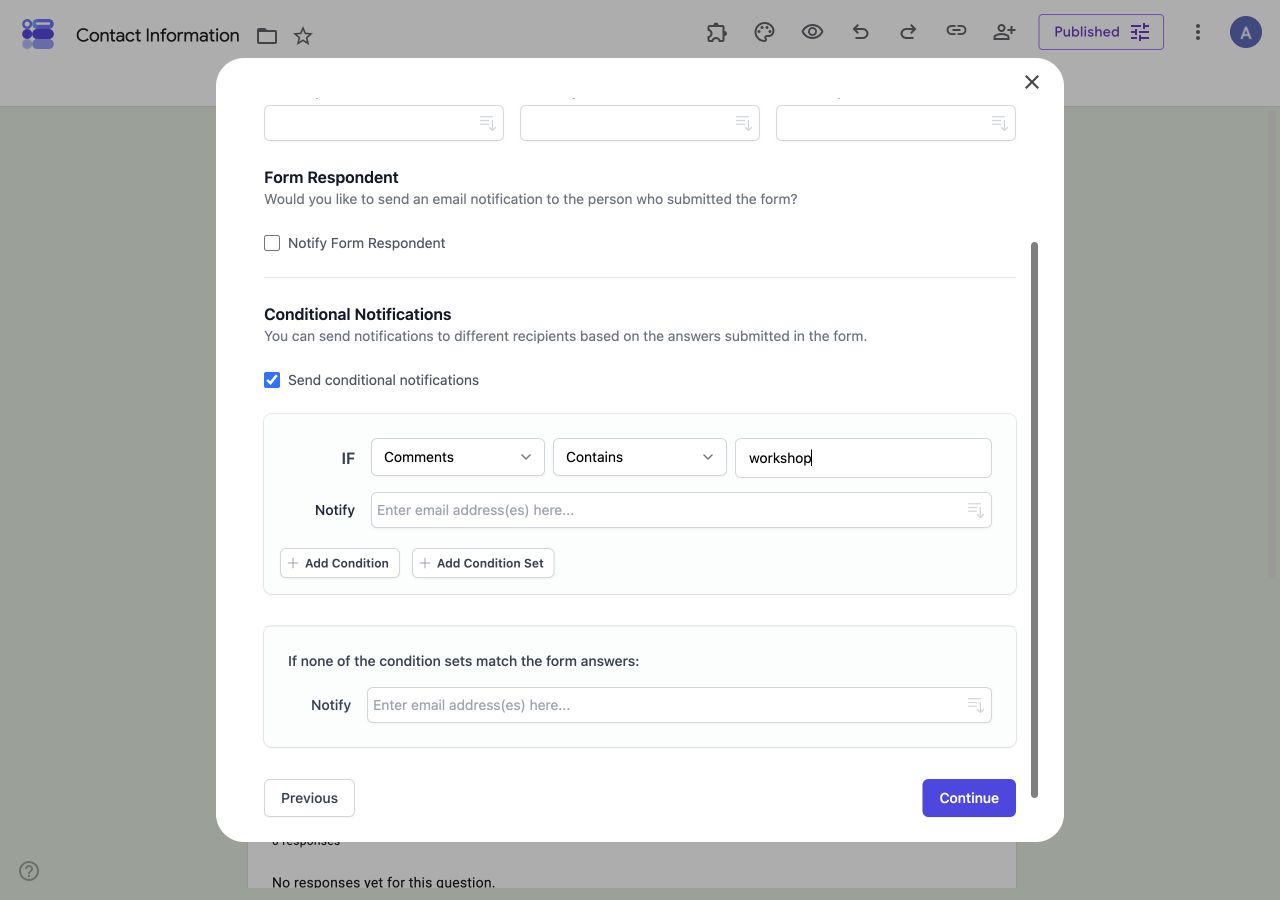
Actual unsaved example: Comments contains “workshop.” Recipient fields are deliberately blank; this screenshot is not an active or complete sending rule.
Our demonstration uses Comments → Contains → workshop because the existing test form has a Comments field. For a production form, a dedicated multiple-choice “Enquiry type” question may produce more predictable routing than free text. A respondent could otherwise write “training session” without using the word “workshop.”
For a fixed-choice question, an equality condition is a reasonable starting point. For free text, a contains condition may be useful, but test capitalization, spelling, and near matches instead of assuming how they behave.
Plan the fallback before saving
A rule should have an answer for an unexpected submission. If someone chooses a newly added option or leaves an optional field empty, who should see it?
The inspected interface provides a fallback notification destination when no condition set matches. Decide whether that should be a general inbox or intentionally remain empty. Also review the ordinary To recipients: they are separate from the recipients inside the condition editor.
Do not assume whether multiple matching sets produce one message, several messages, or a particular precedence order. Use controlled tests to establish the behavior of your saved rule.
Test matching, non-matching, and duplicate alerts
Before using the workflow with customers, save it only after reviewing the remaining setup steps and any account or plan requirements. Then use inboxes you control for these tests:
| Test answer | What to verify |
|---|---|
| A clear match | Correct recipient, subject, and answer values |
| A clear non-match | Intended fallback behavior |
| Blank optional routing field | No accidental recipient or unexplained failure |
| An answer matching multiple sets | Actual overlap behavior |
| A normal submission with native alerts enabled | Whether you receive both native and add-on messages |
If an email is missing, first verify that the response exists in Google Forms. Then inspect the recipient, condition, account status, and spam folder. Google notes that response receipts can be affected by spam filters and anti-abuse measures; an inbox is not a reliable substitute for the stored response record.
Frequently asked questions
Can different answers notify different people?
Pipiform’s inspected recipient editor has answer conditions and recipient fields. Configure the desired routing and verify delivery with controlled tests before relying on it.
Can I notify the respondent too?
The editor includes a separate respondent-notification option. Make sure the form supplies the intended email address and test that path independently from team notifications.
Why am I receiving duplicate emails?
Check whether both the native new-response alert and an add-on rule are enabled. Also inspect overlapping rules and repeated addresses. These are checks to perform, not a diagnosis of every duplicate.
Is a conditional notification the same as a response receipt?
No. A receipt gives a respondent a copy of their submission. A conditional notification routes a message according to the workflow you configure.
What if the add-on will not open?
Use the Google Forms add-on troubleshooting guide. For the mobile-oriented overview, see email notifications on iPhone.