
Turn Google Forms Workshop Feedback into a Useful Report
A response spreadsheet is useful for checking individual answers. A workshop organizer may also need a short document that explains what to change next. This example shows how to move from raw feedback to that document without presenting a tiny sample as a broad conclusion.
All three responses below are invented demonstration data. No customer results, time savings, or automated output are claimed.
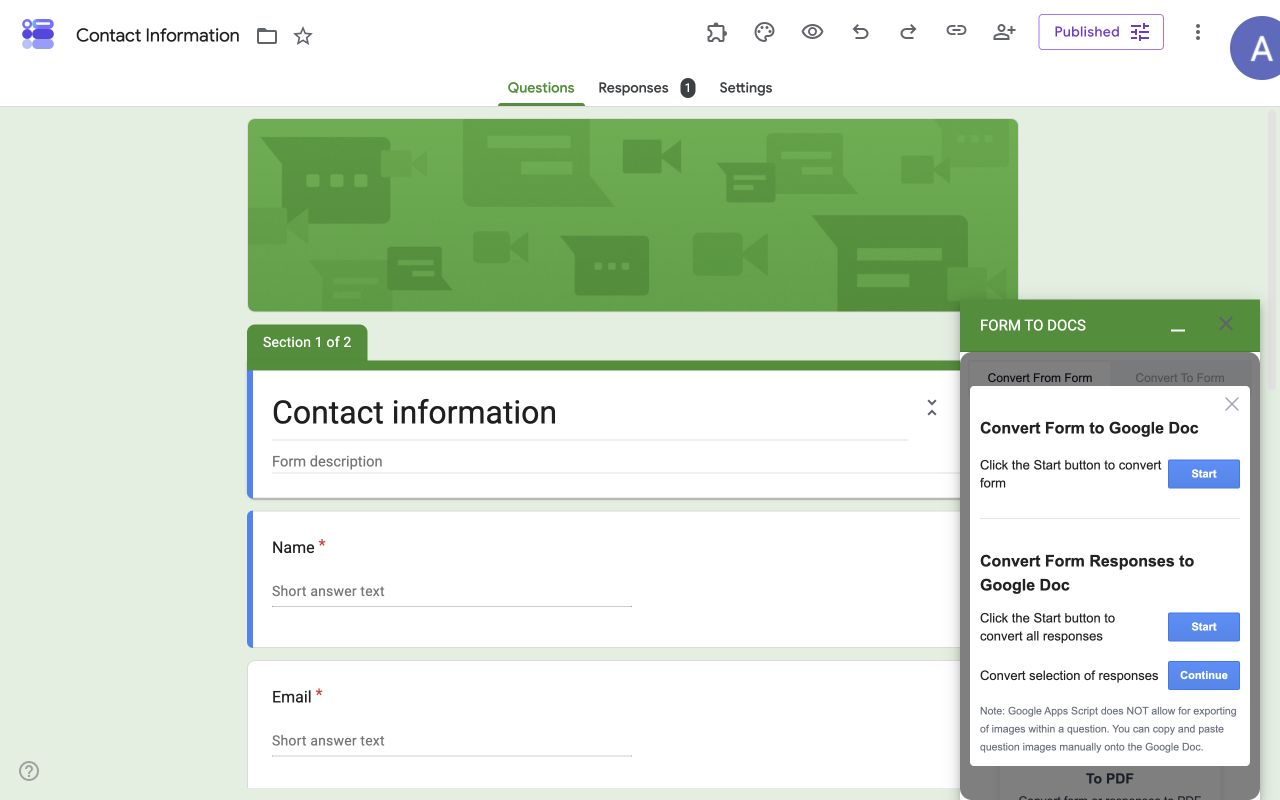 Actual desktop web screenshot showing separate form and response export operations. The feedback dataset below remains fictional.
Collect answers that lead to a decision
For a short workshop, use a session name, a rating with a defined scale, and two comment questions: “What helped?” and “What should change?” Explain that the comments will be used to improve the session.
Avoid collecting a name or contact detail if the report does not need it. If you do need follow-up, decide who should have access to identifiable answers before sharing the output.
Here is the complete demonstration dataset:
| Response | Session | Rating, 1–5 | What helped? | What should change? |
|---|---|---|---|---|
| Demo 01 | Morning | 4 | Worked example | More practice time |
| Demo 02 | Morning | 5 | Clear explanation | Share the checklist |
| Demo 03 | Afternoon | 3 | Question period | Slower opening section |
Download the sample CSV. A rating scale should explain what its endpoints mean; for this example, 1 means “not useful” and 5 means “very useful.”
Write the report around the decision
A useful one-page structure is: scope, response count, findings, and proposed next actions. The sample supports this short report:
Workshop feedback — demonstration report
This report summarizes three fictional responses across two example sessions. The ratings were 4, 5, and 3 out of 5, giving a mean of 4.0. With only three demonstration rows, no general satisfaction claim is warranted.
The comments suggest three follow-ups: allow more practice time, share a checklist, and review the pace of the opening section. Each suggestion appears once. The next organizer should decide which change is practical and collect feedback again after the revised session.
This is more informative than “participants loved the workshop.” It shows the size of the evidence and keeps the proposed actions distinct from observed facts.
Use an export tool for a first draft, then review it
Pipiform’s Form to Docs product page describes exporting forms and responses to document and other formats. If you use it, try one test form and inspect the output before working with real responses.
In the supplied test form, we verified this actual path on September 14, 2026:
- Open Add-ons → Form to Doc - Doc to form → Open.
- Keep Convert From Form selected and choose To Doc.
- Choose the appropriate operation: Convert Form to Google Doc, Convert Form Responses to Google Doc, or Convert selection of responses.
We used the upper Start button, then View, to generate and open a document containing the contact-information form’s question labels and answer lines. This confirms a form-to-document export. It is not a test of exporting the three fictional feedback responses or of generating a report after each submission.
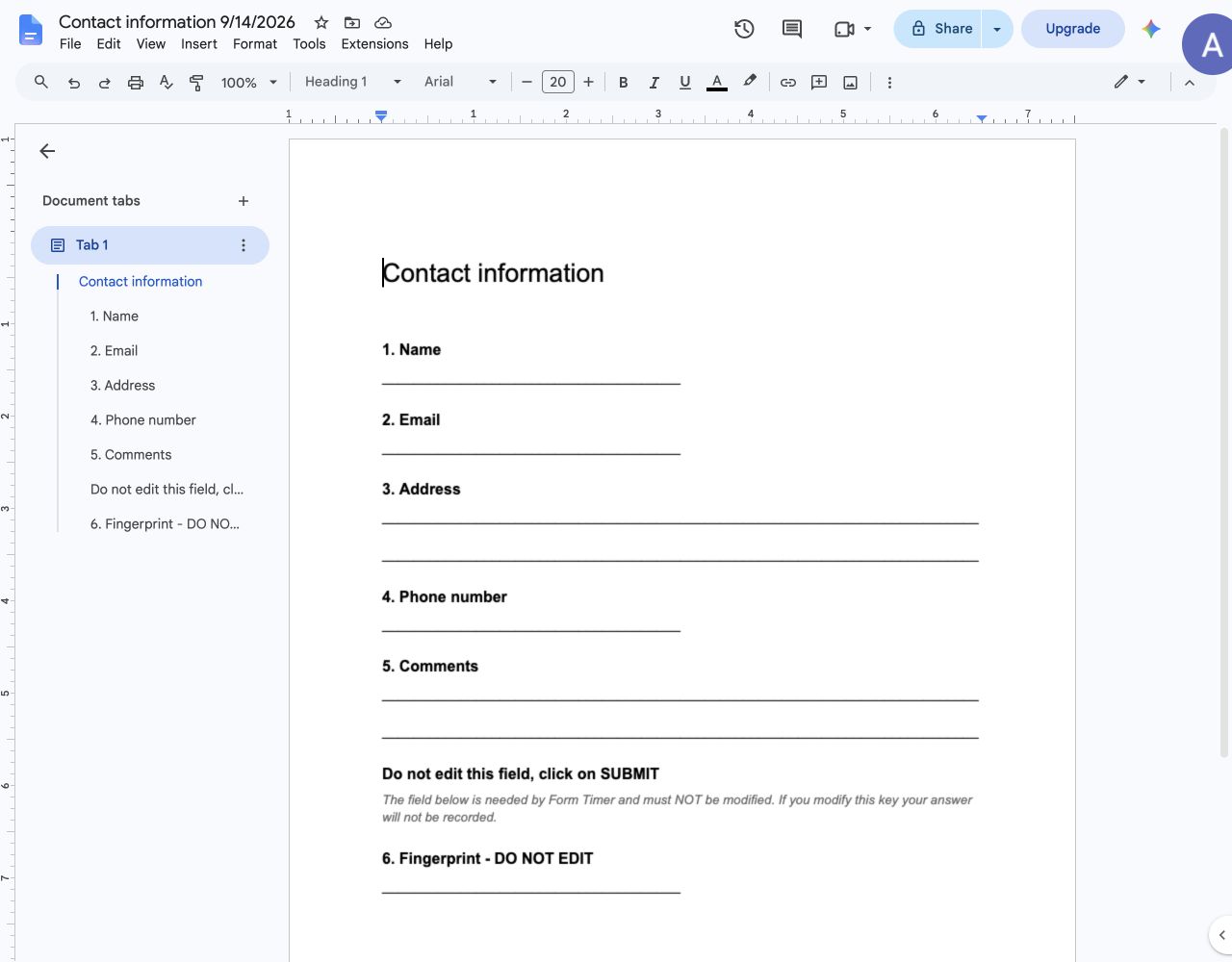 Real exported document, not an AI-generated report. The form’s Timer helper section was also included, so review auxiliary fields before distributing the document.
For the feedback example, use the response operation that matches your intended scope and verify the resulting values. Do not confuse exporting blank question prompts with exporting collected answers.
You can also write the summary manually from the sample CSV. The reporting decisions above remain useful whichever export route you choose.
Inspect the document before sharing
Check whether all three sample rows are represented correctly. Look for cropped long answers, missing headings, awkward page breaks, and a number rendered as text or with the wrong scale. Compare the exported values with the source, then write the short interpretation yourself.
If you share the report more widely than the original response sheet, review whether it still includes names, email addresses, or unnecessary quotations. The audience for an organizer’s summary is not automatically the audience for every raw response.
Decide whether an add-on fits the workload
In the tested account, the displayed free counter changed from “1 time” to “0 times” after one export. Check the allowance shown in your account before starting a conversion. Premium is listed at $49.20/year or $8/month, with separate one-time bundles on the pricing page. Choose based on your tested workflow and expected volume, rather than assuming that every reporting task needs a subscription.
Start by producing this small demonstration report. Once the values and layout are correct, apply the structure to your own event and clearly label any limitations in the real dataset.
If you are still setting up the collection step, start with the iPhone form-creation example and adapt its fields for feedback.